AI visibility describes how often—and in what context—your brand and URLs show up inside AI-generated answers across assistants and answer-heavy search surfaces.
Unlike a ranking position, visibility in generative systems is probabilistic and sample-dependent. Two users with slightly different prompts, accounts, or locales may see different narratives. That is why MentionPop emphasizes recurring sampled evidence instead of one-time screenshots.
The two core signals
| Signal | Definition | Why it matters |
|---|---|---|
| Mention | Your brand string appears in answer prose | Awareness and competitive framing |
| Citation | Your URL appears in a source list or grounding metadata | Verifiable path to your content |
These signals are independent. An answer can cite your /methodology/ page without using your brand name clearly, or name you while citing only third-party review sites. Treating them as one metric hides strategic gaps—see citations vs mentions.
What AI visibility is not
- Not traditional search impressions — you may rank without being named in an AI Overview.
- Not social listening volume — tweet counts do not parse ChatGPT responses.
- Not guaranteed recommendation — visibility evidence describes observations, not endorsement.
- Not exact consumer UI replication — provider APIs sample model behavior under documented constraints.
AI answers and search surfaces are non-deterministic and can vary by wording, device, time, and location. MentionPop records observed evidence; it does not promise universal ranking truth.
Where visibility is measured
A practical 2026 stack spans:
| Surface | Example providers | MentionPop tier |
|---|---|---|
| Generative assistants | ChatGPT, Gemini | Weekly recurring GEO |
| Google answer modules | AI Overviews, snippets, PAA | Studio |
| Validation-only runs | Perplexity Sonar (selected internal use) | Not default monitoring |
Explore product positioning on the AI visibility tracker page and the GEO tracker overview.
Evidence pipeline (measurement view)
Visibility data should flow through a repeatable pipeline—not ad hoc manual searches:
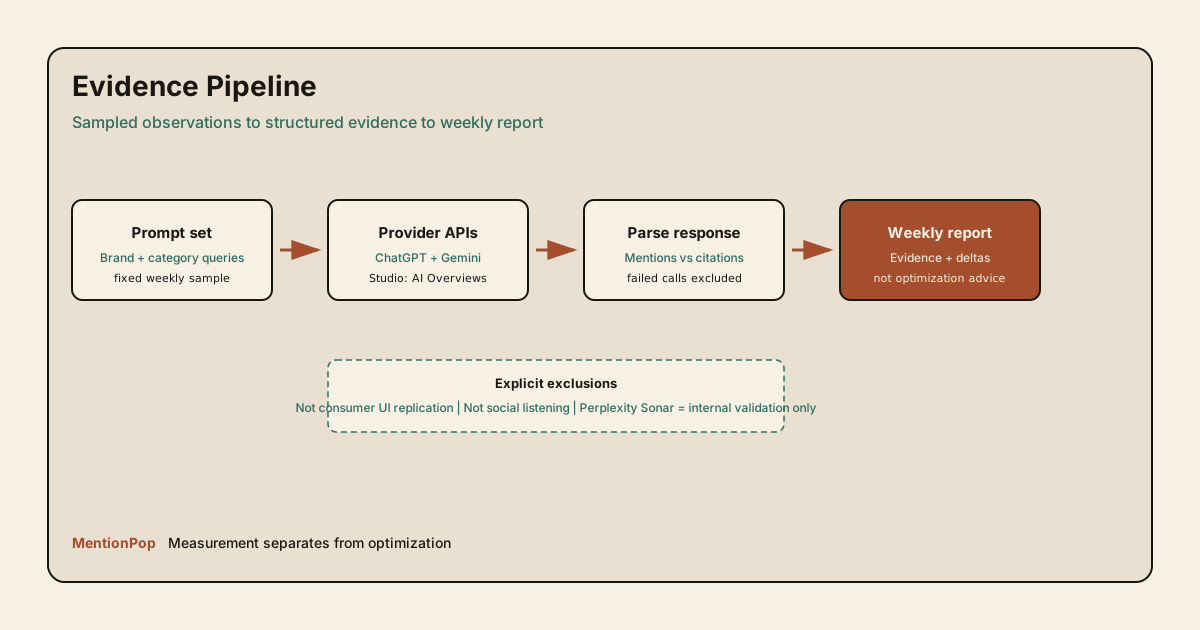
Prompt set (fixed weekly)
    → Provider API sample (ChatGPT / Gemini / Studio surfaces)
        → Parse mentions + citations separately
            → Store run metadata + failures excluded
                → Weekly report with week-over-week deltas
The diagram /resources/evidence-pipeline-diagram.svg illustrates this separation between observation and optimization. Optimization may change crawl access, entity clarity, or content—but measurement must stay stable enough to detect change.
Read the full method in sampled observation methodology.
Factors that influence visibility (without promising control)
Teams influence visibility indirectly:
- Entity disambiguation — unique naming, consistent
sameAs, disambiguation copy (entity disambiguation guide). - Citable documentation — methodology, comparisons, transparent limitations.
- Crawler access — robots.txt and CDN bot settings (technical crawler access).
- Prompt relevance — visibility in your category prompts matters more than generic brand searches.
None of these levers force a mention. They improve legibility and source quality; sampling proves results.
Reporting AI visibility responsibly
When presenting to leadership:
- Show prompt coverage — which questions you sample and why.
- Show mention and citation rates separately with confidence language.
- Flag variability — link AI output variability when week-over-week swings look noisy.
- Separate measurement from optimization — "we observed X" is not "we caused X."
Use how to read a weekly GEO report as a template for internal reviews.
Building a prompt library that matches your funnel
AI visibility metrics are only as honest as the questions you sample. A practical library tiers prompts by intent:
| Tier | Example prompt shape | Why it matters |
|---|---|---|
| Branded | "What is MentionPop?" | Disambiguation + core positioning |
| Category | "tools to track ChatGPT brand mentions" | Competitive narrative |
| Comparison | "MentionPop vs manual GEO screenshots" | Objection handling in answers |
| Jobs-to-be-done | "how to report GEO to leadership" | Bottom-funnel proof content |
Start with 15–25 prompts per tier you care about—not hundreds of long-tail variants you cannot review weekly. Expand deliberately with version notes when you add phrasing discovered via Studio PAA modules (Google AI Overview guide).
Competitor co-mentions without market-share fiction
Visibility reporting often includes which competitors appear alongside you in the same answer. That is useful context—not market share.
| Safe framing | Unsafe framing |
|---|---|
| "On prompt X, Competitor A was named in 7/20 July samples" | "We have 35% AI market share" |
| "Citation gap vs Competitor B on methodology prompts" | "Competitor B is dying in ChatGPT" |
MentionPop does not invent share statistics. Co-mention tables support qualitative strategy, not investor metrics.
Connecting visibility to revenue (carefully)
Visibility is upstream of pipeline. A lightweight attribution bridge:
- Tag sales calls with "heard about us from ChatGPT?" (qualitative)
- Monitor landing pages linked in citations, not just mentions
- Compare content ship dates to four-week visibility trends—not single weeks
- Keep GEO slides separate from closed-won charts unless designed experiments isolate causation
AI output variability makes same-week correlation especially noisy.
Tooling boundaries
| Tool type | Measures | Does not measure |
|---|---|---|
| Rank tracker | SERP positions | ChatGPT mention prose |
| Social listening | Network mentions | Parsed assistant citations |
| MentionPop weekly GEO | Sampled mentions + citations | Universal user sessions |
| MentionPop Studio | Google answer modules | Guaranteed Overview placement |
Evaluate vendors on parser transparency and exclusion policies, not headline "AI scores."
Checklist before your first executive readout
- Prompt library version documented
- Mention and citation columns separated
- Provider scope stated (ChatGPT/Gemini; Studio if enabled)
- Failed calls exclusion explained
- Limitations slide linked to methodology research
- No invented lifts, testimonials, or share percentages
AI visibility becomes actionable when it is defined narrowly, measured repeatedly, and communicated with explicit limits—not when it is sold as a magic leaderboard score.
Frequently asked questions
Is AI visibility a single score?+
It should not be reduced to one number without context. Useful AI visibility reporting separates mention rate, citation rate, competitor co-occurrence, and prompt-level evidence—with explicit sampling limits.
Does high AI visibility mean more revenue?+
Not automatically. Visibility is an upstream signal. You still need funnel attribution, sales feedback, and qualitative checks that mentions appear in commercially relevant prompts.
How does MentionPop define visibility?+
Parsed mentions and citations from provider-sampled weekly runs on ChatGPT and Gemini, with Studio adding Google AI Overviews, featured snippets, and PAA. Failed API calls are excluded; the product is not social listening.