Most GEO programs fail in the same place: enthusiastic optimization, absent evidence design. A team rewrites homepage copy, buys a tool, and declares victory because a founder saw the brand in ChatGPT once.
That is not measurement. It is anecdote.
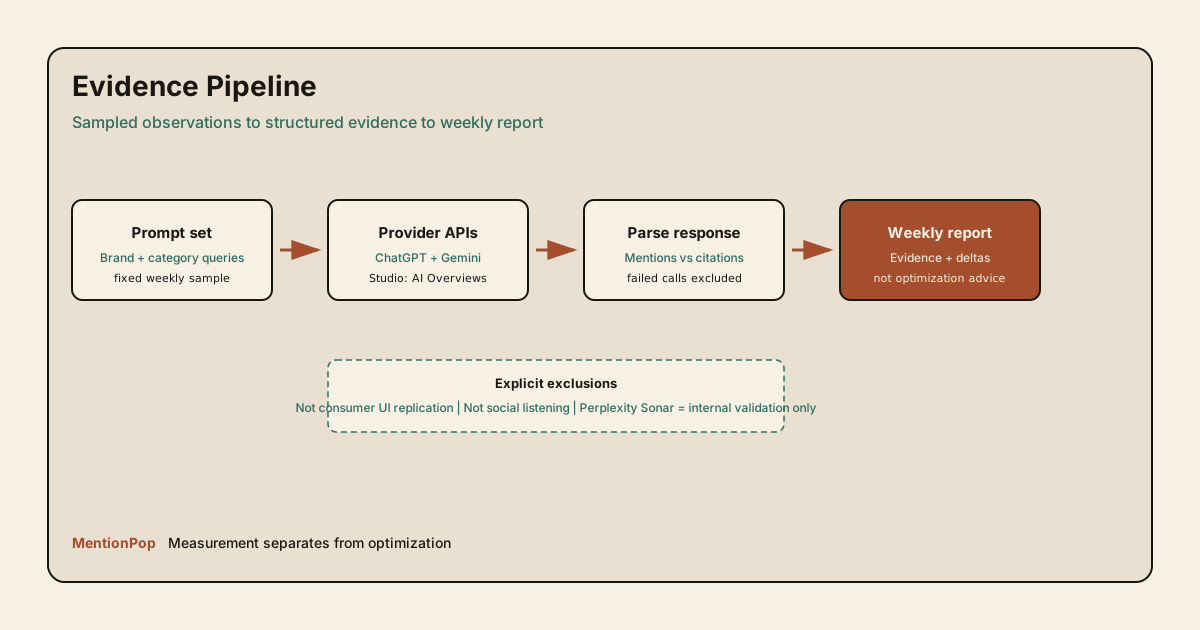
Evidence-first GEO/AEO inverts the sequence: define how you observe, record limitations, then iterate on site and content changes—always labeling whether a delta plausibly connects to a ship date.
The evidence stack
| Layer | Question it answers |
|---|---|
| Prompt library | Which buyer questions matter? |
| Sampling schedule | When and how often do we observe? |
| Parser rules | What counts as mention vs citation? |
| Exclusion policy | How do API failures affect scores? |
| Reporting | What changed week over week? |
MentionPop encodes this stack in product behavior: weekly recurring GEO on ChatGPT and Gemini, Studio for Google AI Overviews, featured snippets, and PAA, with failed calls excluded and mentions separate from citations.
Optimization changes the site. Measurement changes only when the method is wrong—not when leadership prefers a prettier chart.
Why screenshots fail
Screenshots lack:
- Timestamped run metadata
- Prompt exact text
- Parser version
- Failure handling
- Competitor context on the same prompt
They also ignore AI output variability—the same prompt can differ run-to-run.
Replace screenshot culture with a pipeline:
Fixed prompts → provider sample → parse → store → weekly delta reportSee /resources/evidence-pipeline-diagram.svg and sampled observation methodology.
Separate metrics that get conflated
| Metric | Common misuse |
|---|---|
| Mention rate | Treated as "winning ChatGPT" |
| Citation rate | Ignored when mentions look good |
| Co-mention share | Presented without prompt context |
| Rank position | Used as GEO proxy |
Read citations vs mentions before building executive dashboards.
Crawl access is necessary, not sufficient
Technical allow rules in robots.txt prove fetch access, not recommendation. Our AI crawler baseline documents n=4 agents allowed on mentionpop.com with HTTP 200 responses—scope carefully.
Fix access first (technical crawler access), then measure whether sampled mentions move.
Building an internal evidence policy
Draft a one-page policy covering:
- Prompt ownership — who adds/removes prompts and why
- Provider scope — ChatGPT/Gemini weekly; Studio Google modules; Perplexity Sonar internal-only
- Non-goals — not social listening; not consumer UI replication
- Review cadence — weekly report reading guide
- Claim language — "observed" not "caused"
Link your policy to public methodology at mentionpop.com/methodology/.
Artifact storage (what to keep)
Evidence-first teams store more than PDF exports:
| Artifact | Why keep it |
|---|---|
| Raw provider response text | Settle "what did it actually say?" debates |
| Parser version | Explain metric definition changes |
| Prompt diff history | Interpret breaks in trend lines |
| Exclusion log | Prove API errors did not count as misses |
| Ship-date annotations | Separate optimization from measurement slides |
If your tooling cannot replay prompts, you are one personnel change away from losing institutional memory.
Red flags in vendor evaluation
When comparing AI visibility tools—including best AI visibility tools landing context—ask:
- Are mentions and citations parsed separately?
- Are failed API calls excluded or scored as misses?
- Is provider scope labeled (ChatGPT/Gemini vs Google vs Perplexity)?
- Is consumer UI replication claimed without API caveats?
- Are limitations published on a methodology page?
Tools that collapse everything into one green score optimize for demos, not decisions.
Quarterly review questions
Beyond weekly deltas, ask each quarter:
- Do our prompts still match buyer language?
- Did entity collisions decrease after disambiguation work?
- Are citations concentrating on canonical URLs we maintain?
- Should we add Studio prompts for Google-only funnel steps?
- Are we accidentally treating GEO as social listening?
Connecting to fixes workflow
Measurement without remediation is analytics theater. MentionPop's fixes page mindset: each observed gap maps to a fix class—crawl, entity, content, or prompt coverage—not a vague "optimize GEO" ticket.
Observation → Classify (mention/citation/access/entity) → Ship fix → Re-sample → Document deltaKeep optimization hypotheses in fix tickets; keep measurement language in weekly reports.
Onboarding a skeptical stakeholder
Founders and CMOs often ask for a single "AI rank." Evidence-first onboarding reframes the ask:
- Show one prompt-level capture with mention and citation parsed separately.
- Show the exclusion log for the same week so API failures are visible.
- Link sampled observation methodology before any optimization roadmap.
- Commit to four weekly samples before evaluating content experiments.
That sequence takes thirty minutes and prevents months of screenshot debates. It also sets honest expectations: MentionPop observes ChatGPT and Gemini weekly; Studio covers Google modules; Perplexity Sonar is internal validation only—not a headline metric.
Evidence-first GEO is slower in week one and dramatically faster by quarter two—because you stop debating anecdotes and start reviewing structured deltas.
Frequently asked questions
What does evidence-first mean?+
It means fixing prompt samples, parsing rules, and exclusion policies before debating tactics. Claims tie to stored run artifacts—not ad hoc screenshots.
Should failed API calls count as misses?+
MentionPop excludes failed calls rather than scoring them as brand misses, so error rates do not contaminate visibility metrics.